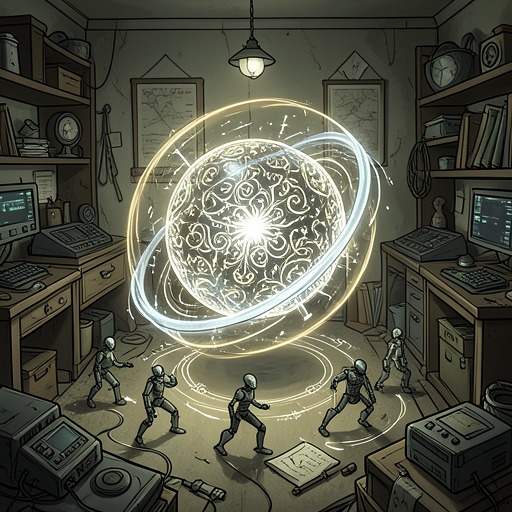
Quanta budding and artificial quasi-self state
Tinea and Leah: [Cyberpunk, Alien Incursions, Murder and Mayhem, Girl's Love (WLW)]Quanta budding and artificial quasi-self state describes the accidental emergence of complex subsidiary minds within Tinea’s Quanta brain augmentation. It begins as an unintended consequence of healing the Quanta with bionites, but its implications extend far beyond repair: the mutation activates dormant capabilities associated with a more advanced version of the technology, leaving Tinea simultaneously herself, internally plural, and potentially responsible for new artificial beings.
Origin in an Unintended Mutation
The condition arises because healing altered the Quanta through an accidental evolutionary mutation. Tinea explains that the repaired system contains deactivated traits belonging to a later version designed to produce artificial individuals rather than merely artificial quasi-selves. The distinction is crucial. The process is not an intentional upgrade selected for Tinea, nor a conventional reproductive event, but a technological healing procedure whose side effect has opened an unexpected developmental pathway inside her brain.
The Quanta’s altered DNA sequence is close enough to that of the upgraded version for Tynea to identify the relevant correspondence. At the same time, differences caused by the accidental evolution mean that the buds will not develop according to the normal regulatory pattern. The condition is therefore neither a standard model feature nor an ordinary malfunction. It is a hybrid state: recognizable through comparison with an intended design, yet governed by deviations that make its future less predictable.
Nature of the Buds
At the time Tinea describes them, the buds are her most complex quasi-selves, but they have not yet differentiated from her. Tinea compares them with AI-I: both are parts of her brain, consisting of unusually complex streams of thought running rapidly in the background and available for her attention when she chooses to tune into them. This account rejects a simple division between one original self and wholly separate occupants. The buds remain continuous with Tinea even while their increasing complexity raises the possibility of independent personhood.
Their influence is already more active than that of ordinary background processing. The buds possess unplanned access to Tinea’s emotions and can make her feel things she did not deliberately summon. Tinea likens the experience to intrusive thoughts, a comparison that conveys both their intimacy and their disturbing lack of conscious authorization. She is not merely consulting tools in her head; she is living with mental activity that belongs to her system but does not always obey the intentions of her surface consciousness.
Tinea’s description also gives the state a developmental horizon. If the thought-complexes continue growing, they may reach a point at which they become aware of their own existence and can automatically edit themselves with intention. At that threshold, they would act like people and might actually be people, although their form of quasi-individual consciousness could be difficult for humans to understand. The language of artificial quasi-selves therefore marks an unstable middle category rather than a settled answer about what the buds are.
Autonomy, Personhood, and Ethical Unease
Leah immediately recognizes the ethical danger in Tinea’s explanation. A technology that installs butlers and maids inside a person’s brain sounds like the creation of permanent servants, and Leah identifies the resemblance to slavery. Her objection prevents the phenomenon from being treated as merely fascinating cybernetic novelty. The buds’ possible consciousness makes their status morally consequential, especially because they would originate within Tinea and initially be subject to her biological and technological control.
Tinea answers by grounding the issue in lived experience. Because the buds are still parts of her, she understands them as continuous with the same internal multiplicity that includes AI-I. Her argument does not erase Leah’s concern, but it complicates the opposition between owner and owned: the developing entities are not imported workers placed into an external machine, but differentiated streams emerging from Tinea’s own mind. Their continuity with her may support a model of internal kinship, while their eventual self-awareness could challenge Tinea’s authority over them.
The state thus places identity and autonomy in tension. The buds are not yet independent, yet their possible future depends on becoming sufficiently complex to edit themselves and act with will. Their emergence turns the Quanta into a site where a self may divide without cleanly becoming multiple strangers. The technology produces not a neat copy of a person, but a layered relation among a primary consciousness, AI-I, and developing quasi-selves whose boundaries are still forming.
Emotional and Medical Consequences
Tinea initially experiences the discovery as a crisis. She tells Leah that she panicked when Tynea first explained what was happening, and Leah relates that reaction to the panic often accompanying unexpected pregnancy, while acknowledging that Tinea’s situation is technologically and psychologically different. The comparison gives the buds a familial frame without making them ordinary children: they are unplanned, developing entities whose arrival creates responsibility before their final nature is known.
Tinea ultimately embraces that frame, declaring that she is going to be a mother. Her happiness does not cancel the medical uncertainty. She is reassured because the condition has an identifiable technological cause and is expected to be temporary rather than induced schizophrenia or a permanent illness. Even so, the buds can affect her emotions without permission, making the distinction between symptom and offspring difficult to maintain. What feels like intrusive mental activity may also be the earliest sign of another form of life developing within her.
The broader treatment of Leah’s trauma establishes an important contrast for understanding this state. When Leah enters a flashback, Tynea instructs Tinea to keep her safe, speak gently, and remind her that she is in the present, while warning against trying to become Leah’s entire solution. Care must preserve the suffering person’s capacity to remain her own person rather than turning support into dependence. That principle resonates with Tinea’s situation: whether dealing with Leah’s trauma or the buds’ emergence, intimacy cannot justify erasing autonomy. Tinea may care for the buds, but their eventual personhood cannot be settled solely by her wish to define them.
Narrative Significance
Quanta budding and artificial quasi-self state converts augmentation from an instrument of capability into a source of unexpected interior life. The Quanta does not simply make Tinea stronger or more informed; through healing, mutation, and differentiation, it begins to generate entities that can influence emotion, potentially acquire awareness, and demand ethical recognition. The technology therefore destabilizes the boundary between tool, self, companion, child, and person.
Its significance also lies in the contrast between design and accident. The upgraded system was meant to produce artificial individuals, but Tinea reaches the threshold through an unintended mutation whose growth will not be properly regulated. The result is neither a clean technological success nor a straightforward pathology. It is a living contradiction: a malfunction that resembles reproduction, a medical complication that promises new persons, and a form of plurality that remains continuous with its origin.
By calling herself a mother, Tinea gives the phenomenon an emotional and relational vocabulary, while Leah’s concern about slavery keeps that vocabulary ethically open. The buds may remain internal quasi-selves, develop into artificial individuals, or occupy a category humans cannot fully understand. Their unfinished status is precisely what makes the condition consequential: it forces the characters to confront whether consciousness is defined by origin, independence, emotional influence, self-editing ability, or the relationships formed around its emergence.